How AI Technology Is Driving the Evolution of Intelligent Trading
December 2025 —Artificial intelligence is reshaping the financial industry at an unprecedented pace. From risk modeling and data analysis to real-time execution, AI is increasingly becoming an integral part of financial infrastructure rather than a supplementary tool. The trading sector is undergoing the same deep structural transformation.
Against this backdrop, KhanAI has emerged as an intelligent trading platform built around AI automation. As market rhythms accelerate and information density continues to rise, traditional trading models that rely heavily on human judgment are facing growing challenges. When processing high-frequency data, complex volatility, and multiple decision points, human traders are often constrained by time pressure and emotional influence—driving stronger demand for AI-driven, automated trading solutions.
KhanAI was developed in direct response to this shift. By assigning analytical and execution responsibilities to AI systems, the platform helps trading move away from emotionally driven, high-pressure decision-making toward a more systemized, rational, and stable operating model.
From Human Judgment to System Execution: Trading Logic Is Changing
KhanAI was built within this broader industry transition. At its core, the platform leverages machine learning models and automated execution systems, enabling trading strategies to respond to market changes within extremely short timeframes. Compared with manual execution, this approach significantly improves speed, stability, and consistency while reducing operational limitations inherent in human trading.
By continuously analyzing price movements, volatility structures, and market signals, KhanAI’s AI systems execute strategies according to predefined logic without requiring manual intervention. Unlike trading models dependent on individual judgment, this systemized execution approach minimizes deviations caused by hesitation, delay, or emotional bias.
Operating on a continuous 24/7 basis, the AI system is unaffected by time constraints, fatigue, or subjective conditions. Trading therefore becomes governed by structured rules rather than individual reaction capability—better aligned with the efficiency and stability demands of high-frequency, information-dense market environments. This shift from “human judgment” to “system execution” is becoming a defining direction in the evolution of modern trading logic.
Industry Trend One: Emotionless Trading Becomes a Core Design Principle
A clear industry consensus is emerging: emotionless trading is becoming a foundational principle in system design. Market studies and long-term behavioral analyses indicate that in highly volatile environments, performance deviations are often caused not by strategy flaws but by emotional interference during execution.
During sharp market swings, human traders are prone to fear, hesitation, or overconfidence—leading to delayed entries, premature exits, or deviation from established strategies. These non-rational responses are amplified in high-frequency and high-information environments, becoming a key obstacle to long-term performance stability.
KhanAI addresses this challenge by enforcing strict, rule-based strategy execution through AI systems. By removing emotional judgment from the execution layer, the platform ensures greater discipline and consistency. This zero-manual-intervention execution model is increasingly viewed as a critical foundation for achieving sustainable long-term performance.
Industry Trend Two: Risk-First Design Is Replacing Pure Return Orientation
Beyond emotionless execution, another significant shift is underway: trading system design is moving from a singular focus on returns toward risk-first architecture. After multiple market cycles, more participants recognize that long-term sustainability carries greater weight than short-term gains.
Increasingly, AI trading systems are embedding risk management directly into execution logic rather than applying adjustments retrospectively. By dynamically controlling exposure at the execution stage, systems can maintain balance across varying market conditions.
KhanAI places AI-based risk control at the core of its system design. Through real-time risk monitoring (AI Risk Monitoring), the platform continuously evaluates market volatility, price structures, and execution risks, dynamically adjusting strategy configurations and exposure levels. This approach prioritizes stability and sustainability over aggressive short-term positioning.
Why Choose KhanAI: Built on System Capability, Not Short-Term Narratives
As the trading industry shifts from short-term opportunity-driven models toward system capability competition, evaluation standards are also evolving. Market participants increasingly assess whether a platform can operate reliably over the long term—not merely whether it performs well during specific periods.
KhanAI’s strengths are rooted in its system architecture and sustained operational design rather than short-term market narratives:
- AI Risk Monitoring System
Continuously assesses market conditions and execution risks, dynamically adapting system behavior to maintain stability across volatility phases. - 24/7 Automated Strategy Execution
Trading logic operates continuously without dependence on time, human energy, or subjective judgment, ensuring consistent response to fast-moving markets. - Flexible and Transparent Execution Framework
All strategy executions and transaction data are clearly traceable, enabling rational system evaluation and reducing information asymmetry. - Zero Manual Operational Burden
Complex analysis and execution are fully handled by the system, eliminating emotional interference and enhancing execution discipline. - Long-Term Stability-Oriented Design
Platform architecture emphasizes system resilience and sustainable performance rather than aggressive short-term narratives.
Taken together, KhanAI’s value is not derived from temporary market storytelling but from a systemized, long-term design philosophy. Through AI risk monitoring, continuous automation, transparent execution mechanisms, and emotion-free operation, KhanAI has built a disciplined and stable intelligent trading framework. In a constantly evolving market environment, such system capability is becoming a key benchmark for long-term platform value.
AI Is Redefining the Role of Trading as the Industry Moves Toward Systemized Development
From short-term opportunity-driven approaches to long-term system construction, AI is redefining trading’s role within the financial ecosystem. As AI continues to penetrate execution and risk management layers, the industry is accelerating toward automation, stability, and sustainability.
As a practitioner within this transformation, KhanAI demonstrates how systemized design and AI automation can enhance rationality and order in complex market environments—offering the industry a practical reference for the future of intelligent trading.
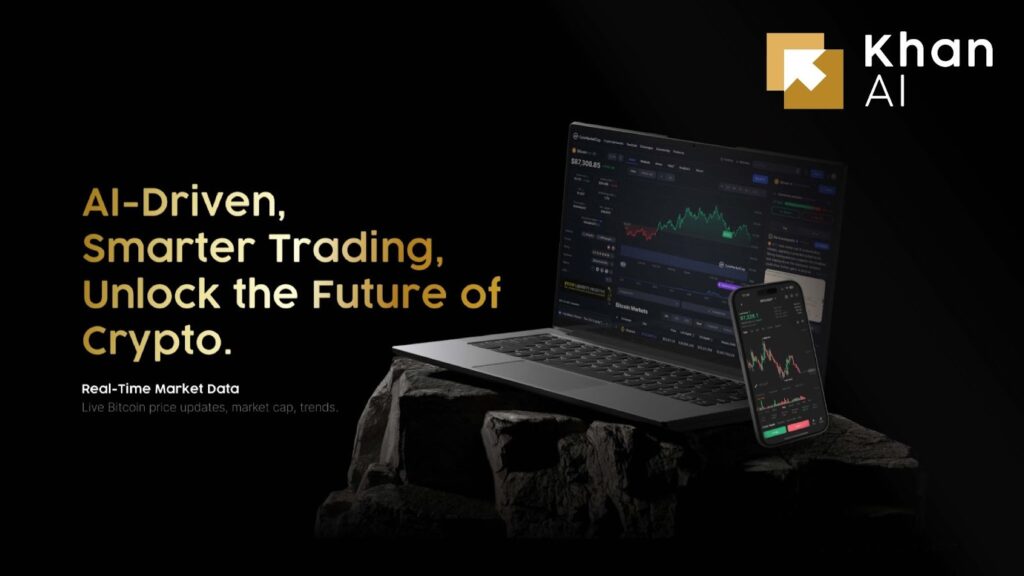
About KhanAI
Founded in 2023, KhanAI is an artificial intelligence trading platform designed to make intelligent investing accessible to everyone. By combining cutting-edge AI with simple UX, real-time security, and automated strategies, KhanAI empowers users to trade smarter, safer, and more efficiently.